30 COMPANIES / 30 DAYSDAY 01
Faye.
Distribution
Nov 17, 2026The commercial thesis
Travel insurance distribution depends on reaching travelers at relevant buying moments.
Independent research · International commerce
Based in the United StatesUnderstanding how the global
travel industry actually works.
I study how travel businesses grow through distribution, partnerships, customer relationships, and international commerce.
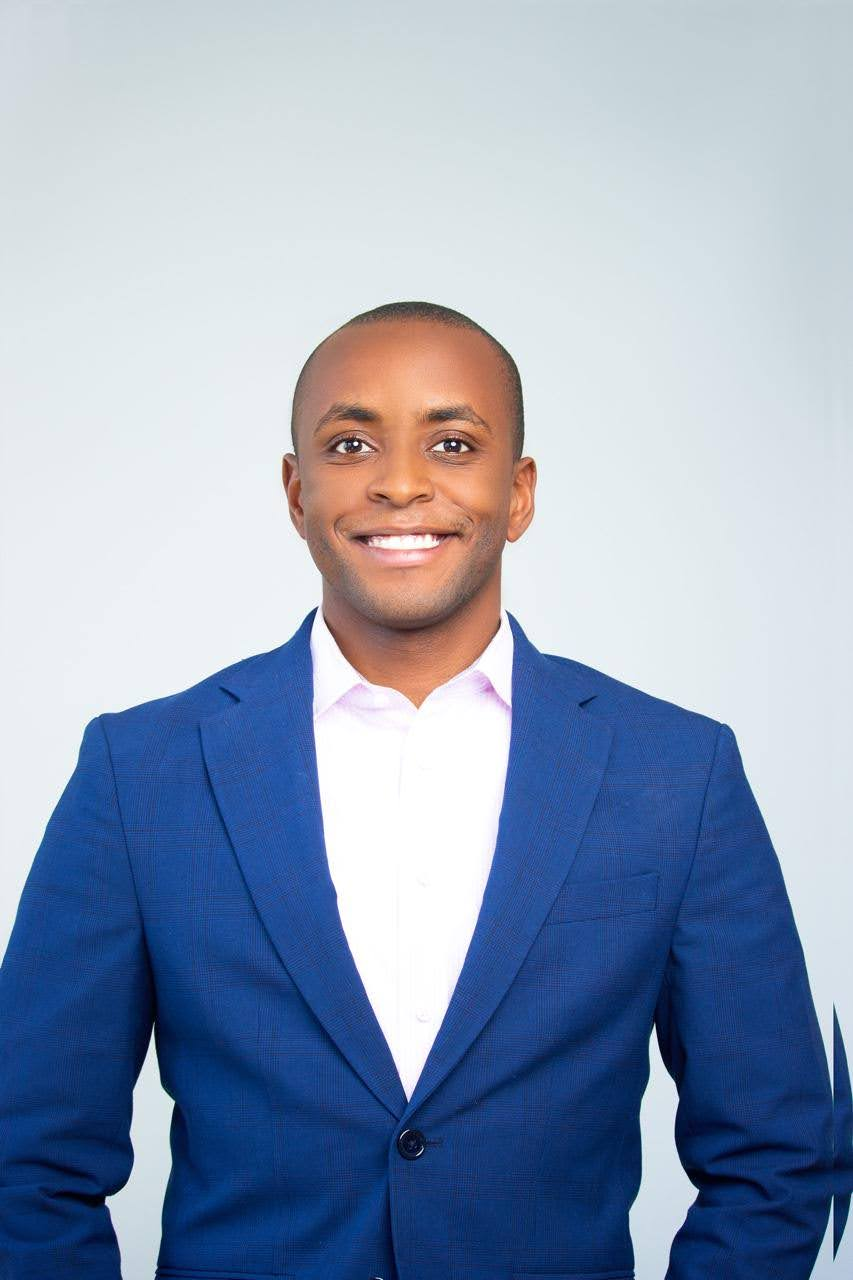 Researcher. Relationship builder. Writer.
Ideas, relationships, and evidence
A few ways I put my curiosity to work.
Independent commercial research
Ongoing series
A closer look at the business models, distribution decisions, and relationships behind global travel companies.
02Partnerships & event coordination
August 2026
Co-organizing a travel & hospitality hackathon. Bringing together the people building what comes next.
03Original writing & analysis
197 original posts
My observations on travel, commercial development, and lessons from building WanderWorth.
George Maina Mwangi
United States · U.S.–Africa perspective
BA in Economics
The Ohio State University · Class of 2022
The person behind the work
I am interested in the businesses, technologies, and relationships that make international travel possible.
My background includes economics, commercial research, business development, sponsorships, original writing, and working with founders and executives across the travel industry.
I founded WanderWorth in May 2025. Over approximately 17 months, the project evolved through three experiments:
I explored software ideas, researched operating problems, and learned from customer conversations about commercially significant demand.
I explored consumer travel advisory and learned about distribution, customer acquisition, purchase intent, and the economics of selling travel.
I built relationships across travel technology and hospitality. This ultimately led to co-organizing Checkout in New York City.
WanderWorth concluded operations in October 2026. The experience helped shape my current specialization in international B2B commercial development.
My executive ghostwriting and newsletter services were discontinued in November 2026.
Today
I publish independent research on travel companies, build relationships across the industry, and develop skills in writing, video storytelling, and commercial analysis. My long-term objective is to build and operate an independently owned, profitable travel-industry business.
Distribution, supplier relationships, operations, and commercial strategy.
Investigating companies and identifying commercially relevant questions.
Sponsor research, stakeholder mapping, outreach, and partner engagement.
An international background, with familiarity with Kenya and East Africa.
Flagship case study · Co-organizer
August 9, 2026 / New York City
I co-organized Checkout with Somya Gupta, bringing together developers, founders, designers, travel-industry professionals, sponsors, and judges to explore real problems in travel and hospitality technology.
Official project gallery320+
Registrations
100+
Attendees
14
Submitted projects
7
Stay22 API integrations
My contributions
Sponsorship research, sponsor relationship development, targeted outreach, audience research, commercial communications, event coordination, and partner engagement.
I personally developed the relationships with Stay22 and Rove.
Developer teams were responsible for building their projects and integrations. The results above are event-wide.
Cash sponsorships
$3,500 totalBuilt by the participating teams
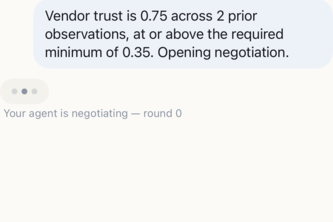
Personal Agent which can find specialised agents to any tasks including planning an itinerary over blockchain
A website to plan group trips that can adjust itineraries based on the groups preferences and if the number of days needs to change.
CareStay is a hotel search for medical travel where an AI voice agent calls hotels to verify accessibility and room requirements that no website lists.
Travel chatbots are failing disabled travelers because the data is patchy. We're fixing that by calling the hotels, getting detailed info and supplying the accessibility database to websites.
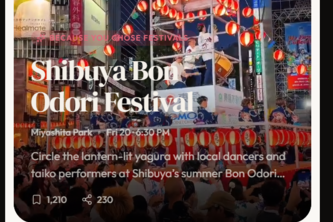
Roam mixing media and travel, helping travellers find their next event or attraction.
AI operations copilot for luxury travel advisors that researches, verifies, and calls suppliers, even across languages.
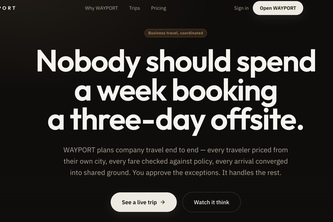
Our project addresses enterprise travel. We use agents to negotiate, book, and schedule flights, hotels and itineraries for business trips.
An AI copilot for human travel advisors that demonstrates the "last mile" between web research and a recommendation an advisor can defend in front of a client.
Smarter travel. Smaller footprint.

Turning the messy group-chat conversation into one trip plan everybody can actually agree on.
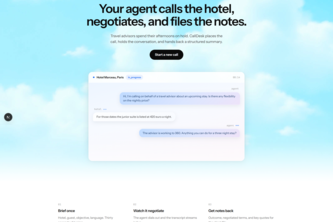
AI that calls hotels for travel advisors: negotiates rates and upgrades live, then turns the conversation into structured call notes you can drop into a client file.
Your hotel room phone, reimagined as an AI concierge.

Unplanned: for travelers who didn't plan. Tell it what you're into, it finds, books, even calls the venue to lock in your night. From lost to a booked evening in under a minute.
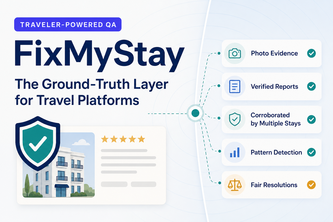
The ground-truth data layer for travel platforms: travelers report stay issues, we find supporting evidence, and partners see fair resolutions.
An ongoing independent research series
Understanding how the global travel industry actually works. I independently study how travel companies operate, distribute their products, form partnerships, acquire customers, and grow.
Faye.
Distribution
Nov 17, 2026Travel insurance distribution depends on reaching travelers at relevant buying moments.
Tern.
Travel technology
Nov 18, 2026Travel advisor software, hotel distribution, transaction economics, and supplier relationships influence agency adoption.
Independent analysis. Not commissioned or endorsed by the companies featured.
Original thinking, published in public
A collection of my writing about travel businesses, the people building them, and what I've learned through independent research and professional experience.
Today I write primarily about the business of travel: distribution, booking technology, partnerships, customer acquisition, hospitality, aviation, and commercial development.
All publications are my original writing. Earlier posts preserve the context in which they were written; references to discontinued services are historical, not current offers.
Travel · Distribution
Published November 17, 2026. An independent eight page PDF carousel comparing four ways Faye distributes travel insurance: through TravelJoy inside the travel advisor workflow, Ski.com at ski trip checkout, Yonder as a coverage comparison option, and Guesty through referral links in guest messages. I compared each channel on purchase intent versus audience reach, commissions, public claims, and feasibility, and closed with my own six factor framework for evaluating distribution partners. This is independent analysis, not work endorsed by Faye, and any policy volume calculations in it are illustrative, not company results.
Read original on LinkedIn : Faye’s Distribution Strategy: Four Buying MomentsTravel · Distribution
Published November 16, 2026. A breakdown of how Faye's travel insurance reaches travelers through TravelJoy's advisor booking workflow: where insurance appears as advisors plan and book trips, how qualifying advisors can earn commissions, and why distributing through relationships advisors already have with their clients can be more natural than reaching travelers cold.
Read original on LinkedIn : Faye × TravelJoy: Advisor Led Insurance DistributionTravel · AI
Published November 13, 2026. Podcast informed analysis drawing on a Kaptio Unite conversation featuring insights from Tauck, the tour operator. The piece argues that technology only creates value when it is implemented well and supports the human relationships at the center of travel, rather than being treated as an automatic answer to every operational problem.
Read original on LinkedIn : Not Every Travel Problem Needs a Technology SolutionTravel · Distribution
Published November 9, 2026. Using three commercial examples from travel industry podcasts, I looked at why travel technology companies often describe complex features instead of the outcomes customers care about, and how connecting those features to customer results can strengthen sales conversations and positioning.
Read original on LinkedIn : Why Travel Tech Companies Struggle to Explain Their ValueThe complete collection
More observations first, followed by older event and sponsor announcements kept for the record.
Showing 9 of 197 posts
Travel · Distribution
Published November 17, 2026. An independent eight page PDF carousel comparing four ways Faye distributes travel insurance: through TravelJoy inside the travel advisor workflow, Ski.com at ski trip checkout, Yonder as a coverage comparison option, and Guesty through referral links in guest messages. I compared each channel on purchase intent versus audience reach, commissions, public claims, and feasibility, and closed with my own six factor framework for evaluating distribution partners. This is independent analysis, not work endorsed by Faye, and any policy volume calculations in it are illustrative, not company results.
The best distribution partner is not always the one with the largest audience; it is the one that reaches travelers at a real buying moment.
Travel · Distribution
Published November 16, 2026. A breakdown of how Faye's travel insurance reaches travelers through TravelJoy's advisor booking workflow: where insurance appears as advisors plan and book trips, how qualifying advisors can earn commissions, and why distributing through relationships advisors already have with their clients can be more natural than reaching travelers cold.
Embedding a product inside a trusted advisor's existing workflow turns an existing relationship into a distribution channel.
Travel · AI
Published November 13, 2026. Podcast informed analysis drawing on a Kaptio Unite conversation featuring insights from Tauck, the tour operator. The piece argues that technology only creates value when it is implemented well and supports the human relationships at the center of travel, rather than being treated as an automatic answer to every operational problem.
Implementation and relationships often matter more than the technology itself.
Travel · Distribution
Published November 9, 2026. Using three commercial examples from travel industry podcasts, I looked at why travel technology companies often describe complex features instead of the outcomes customers care about, and how connecting those features to customer results can strengthen sales conversations and positioning.
Buyers rarely purchase features; they purchase outcomes they can clearly picture.
Travel · Distribution
USC beat Ohio State 30 to 18, but I was thinking about another winner: United Airlines, which signed a 10 year agreement with USC in 2019 that included naming rights to the playing field at the Los Angeles Memorial Coliseum, a natural fit given United's LAX hub. I researched other airline partnerships in college football: Delta with University of Georgia Athletics for more than 40 years, expanded in 2025 to include field branding at Sanford Stadium; Sun Country as the official airline of University of Minnesota Athletics since 2023, with a Gophers branded aircraft and NIL opportunities; Alaska with San Diego State in 2024, including naming rights to a Snapdragon Stadium entrance; JetBlue as the official airline of Boston College Athletics; and Delta with Georgia Tech. The geographic pattern is clear, but the more interesting question is what happens beyond the branding: college football creates travel demand through team charters, fan and alumni travel, loyalty programs, and customer acquisition.
Airline sponsorships of college athletics follow each airline's home market, and the real question is how airlines measure the return on those partnerships.
Travel · Distribution
They need better ways to build and maintain strategically valuable relationships. Checkout brought together 100+ people who built 14 public projects using APIs from real travel companies, but the most valuable part was what happened because the right people were in the room: companies met builders, builders met operators, and sponsors met potential users. Depending on the problem, that can mean mapping accounts and warm paths, sharpening an executive's point of view on LinkedIn, building a conference strategy, making targeted introductions, or getting the right people into a private dinner or roundtable.
The mechanism depends on the problem. The relationship will always be the product. If your company could build stronger relationships with only 10 organizations over the next year, which 10 would matter most?
Travel · Founder Lessons
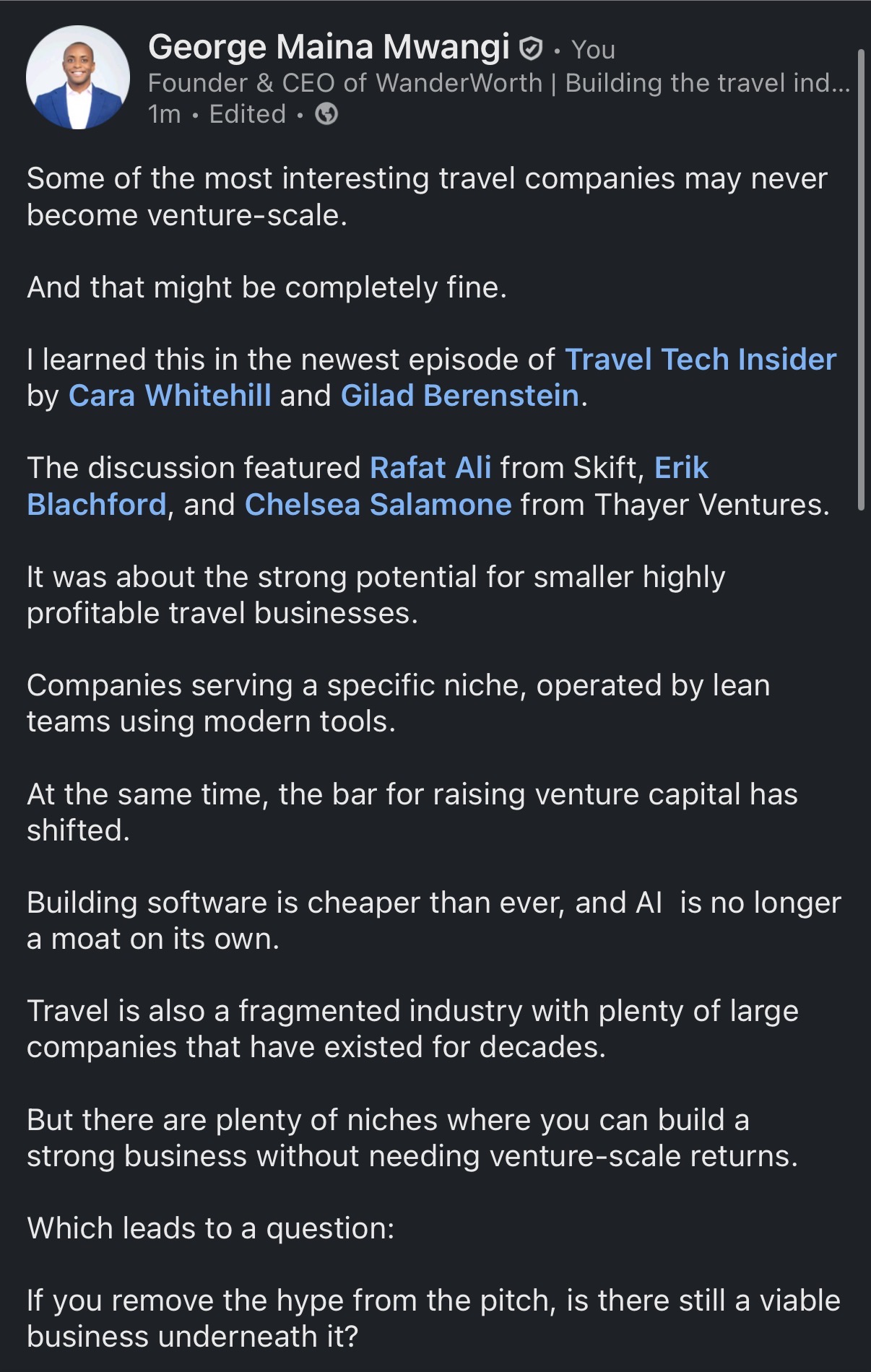
Reflecting on a Travel Tech Insider conversation with Cara Whitehill, Gilad Berenstein, Rafat Ali, Erik Blachford, and Chelsea Salomone, George considers the potential for smaller, highly profitable travel businesses. Software is cheaper to build and AI is no longer a moat on its own, but travel remains fragmented and full of valuable niches that lean teams can serve. The episode challenges fundraising as the default measure of startup progress and returns attention to what sustains a company: customers, distribution, and relationships.
Remove the hype from the pitch and ask whether a viable business remains. Technology can make customers, distribution, and relationships more efficient, but it cannot replace them.
Events · Distribution
A startup can spend heavily to exhibit at a major hotel conference, leave with hundreds of badge scans, and still struggle to get 20 uninterrupted minutes with the independent hotel owner, GM, or VP of Operations they actually want to understand. Large trade shows are extremely good at reach — visibility, partner meetings, and a place for established vendors to maintain relationships at scale. But an early-stage hospitality tech company often has a different problem: it needs depth. Compare the exhibition hall with a dinner of 10 to 12 deliberately selected hotel owners, GMs, operators, and technology leaders. Instead of “What does your product do?”, the conversation can become: How do you evaluate new software? Who actually owns implementation? Where does the buying process get stuck? Why did the last tool fail? What problem is painful enough to get budget this year?
Intimate gatherings don't replace major industry conferences — they solve a different distribution problem. Large events create reach; smaller, highly curated rooms create depth of access. For companies selling into independent hospitality, buyer density matters just as much as audience size.
Distribution · Founder Lessons
Everyone should add the book You Can Just Do Things by Jay Yang to their reading list. Chapter 12 is specifically about making your move by reaching out to people directly — but you have to do it correctly. Messages like “I came across your profile” and “Can I pick your brain?” fail because they're templated and generic. Chapter 12 gives a framework for cold outreach that works: a specific reason for reaching out, a clear hook, a short message, and one ask. I've been testing that over the past few weeks by reaching out to people, and people are actually responding. Two reasons why: the emails are simply better — more research beforehand, and it's obvious why I'm reaching out to that specific person — and I'm targeting people who are harder to find. The people who are easiest to contact are the most likely to get dozens or even hundreds of messages a day; many of the people I'm contacting can be found through harder sources like industry podcasts and trade associations.
Cold outreach is by no means dead — bad cold outreach is dead. Sometimes the opportunity isn't in sending more emails; it's in finding better people and giving them a real reason to respond. That is the same principle behind WanderWorth's relationship development work: research, relevance, and a real reason to engage beat volume every time.
A different way to tell the story
In 2026 I participated in Rove's first Creator Sprint and produced more than 20 short-form videos exploring travel experiences, rewards, hotels, airline partnerships, and related topics.
Instagram · Original short-form video
Travel storytelling from Nairobi, Kenya.
Watch original videoInstagram · Original short-form video
Exploring airline partnerships and travel rewards.
Watch original videoWhat I'm developing next
I have enrolled in Kevin Kim's Short-Form 30 program, beginning November 23, 2026. My objective is to use video storytelling to communicate travel-industry research more clearly across Instagram and TikTok.
Good conversations open doors
I'm always interested in thoughtful conversations with people building and operating businesses across the global travel industry.
Whether you're working in travel distribution, hospitality, technology, partnerships, or international business, I'd be glad to connect.